Every camera in this guide records to a memory card and asks for nothing monthly to do it, which quietly removes the feature most shoppers compare first. What separates the best home security cameras from the ones that end up in a drawer is far more physical: whether the spot it is going on has an outlet, a cable run, direct sunlight, or nothing at all. That question is settled by the hardware on the day it is bought.
This guide covers eight of the best home security cameras, one for each situation, from a magnetic indoor unit to a dual-lens model that sees 180 degrees in a single frame. The criteria behind every pick, the models left out, and the buying questions worth asking are all set out further down.
Best Home Security Cameras Compared
The best home security cameras below are not ranked against each other. Each one wins a specific category, so the quickest route is to find the row that matches the situation and jump straight to it.
| Category | Product | Why it is here | Jump to |
|---|---|---|---|
| Indoor | Tapo C120 | 2K detail and a magnetic base, with the full detection set unlocked. | Tapo C120 |
| Budget | Tapo C101 | The simplest camera here, with person detection that costs nothing to run. | Tapo C101 |
| No subscription | Reolink E1 Outdoor Pro | Real optical zoom and four places to put the footage, none of them paid. | Reolink E1 Outdoor Pro |
| Wire-free battery | Tapo C400 | Goes on a wall with no outlet, no cable and no hub. | Tapo C400 |
| Floodlight | Wyze Cam Floodlight v2 | 2800 lumens of light with a camera behind it, recording to a card. | Wyze Cam Floodlight v2 |
| Solar | Reolink Argus PT Ultra | Runs on 20 minutes of sun a day and turns to follow movement. | Reolink Argus PT Ultra |
| Tracking movement | Tapo C660 KIT | 4K tracking across a full sweep, with the solar panel in the box. | Tapo C660 KIT |
| Wide view | Reolink Duo 3 WiFi | Two lenses stitched into one 180 degree frame at 16MP. | Reolink Duo 3 WiFi |
Best Indoor Security Camera: Tapo C120

This is the camera for a hallway, a nursery or a back room, and it is unusual in the indoor class for being rated for outdoor use as well. The magnetic base is the part owners notice. It sits on a shelf, sticks to a metal surface, or screws to a wall, and it moves in seconds when a room changes.
Key Specs
- 2K QHD 4MP at 2560 x 1440, 20 fps
- 120 degrees diagonal, 103 degrees horizontal field of view
- IP66 weather rating for indoor or outdoor placement
- Starlight sensor with dual spotlights for full-color night vision
- 940 nm invisible infrared to 30 ft
- microSD to 512 GB, roughly 680 hours of 2K footage
The detection is what lifts it above its price bracket. TP-Link’s published specifications list person, vehicle, pet, line-crossing, baby cry, bark, meow and glass-breaking detection, all running on the camera itself with no plan attached. Invisible infrared earns its place in a bedroom, where the usual ring of red LEDs is the reason a camera gets unplugged.
The caveat is the wire. This is a plug-in camera on a 3 meter USB-C cable, so every placement becomes a question of where the nearest outlet is, and it joins 2.4 GHz networks only.
- Free on-device detection covers people, vehicles, pets and breaking glass.
- Invisible night vision watches a dark room without a red LED glow.
- The magnetic base moves the camera to a new spot in seconds.
Best Budget Security Camera: Tapo C101
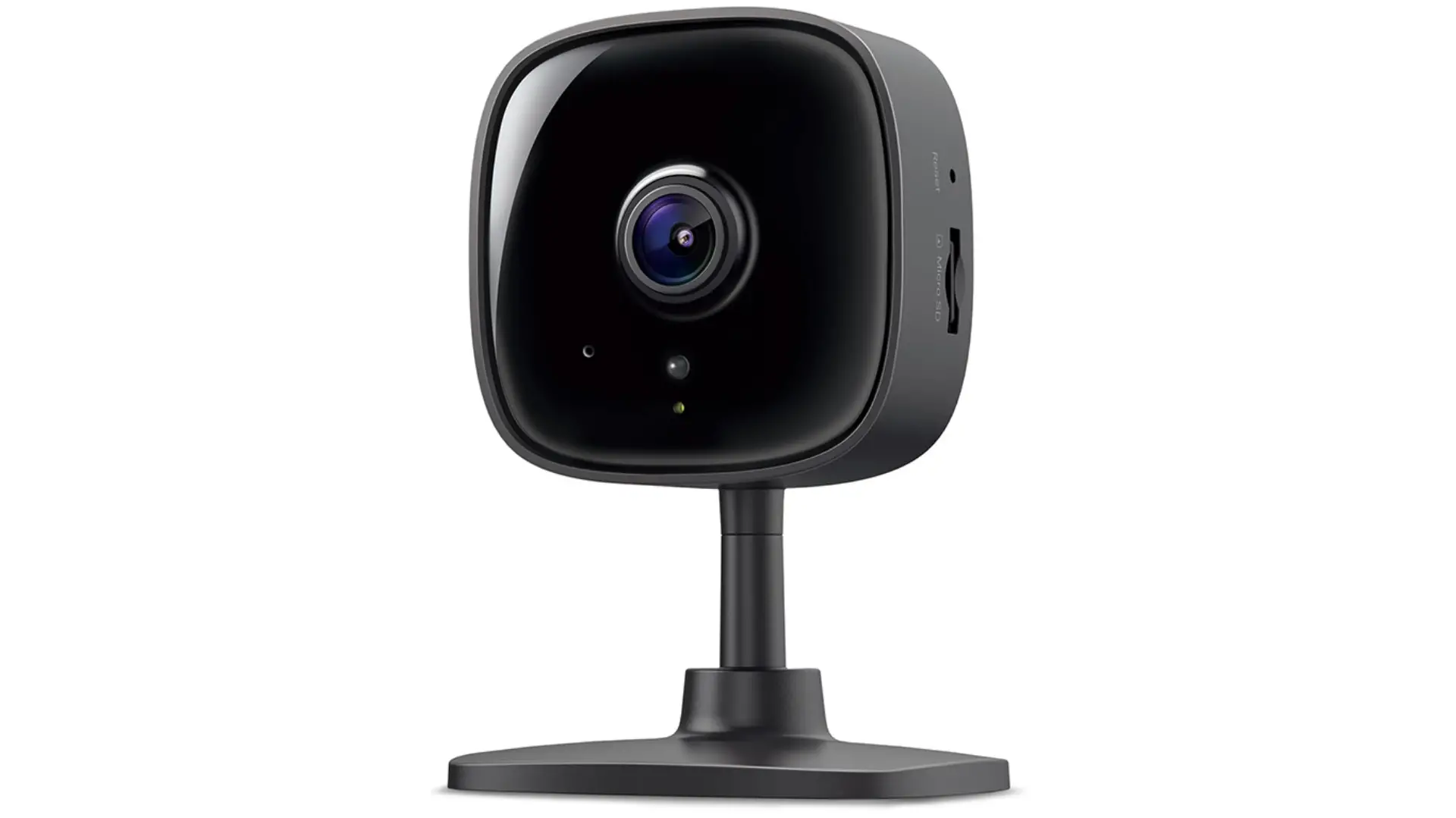
This is the entry point, and the honest version of what an entry point buys. It watches a room, talks back, and records to a card, which covers the job most first cameras are actually bought for.
Key Specs
- 1080p at 1920 x 1080, 15 fps
- 117 degrees diagonal, 98.8 degrees horizontal field of view
- Infrared night vision to 40 ft
- Person, motion and baby cry detection with no fee
- Privacy zones that block chosen areas from recording
- microSD to 512 GB
The privacy zones deserve more attention than they usually get. Areas of the frame can be blocked out entirely, so a camera pointed at a doorway does not also record the bed behind it. That is the difference between a camera a household accepts and one that ends up covered with a sock.
Two caveats belong together here. The sensor is 1080p and TP-Link’s specification table states plainly that it is not a starlight sensor, so night footage is infrared black and white rather than color. It also carries no weather rating, which makes it an indoor camera only.
- Person and baby cry detection run on the camera with no plan.
- Custom privacy zones keep chosen parts of a room out of every recording.
- Records to a card, so the running cost after purchase can be nothing.
Best Security Camera Without a Subscription: Reolink E1 Outdoor Pro

Plenty of cameras record locally. This one is here because it does that to four different destinations and carries a genuine optical zoom, which is what decides whether footage of an incident is useful or merely proof that something happened.
Key Specs
- 4K 8MP at 3840 x 2160, 20 fps
- 3x optical zoom, 94 degrees horizontal at the wide end
- 355 degree pan and 50 degree tilt, with 64 preset positions
- Auto-tracking that follows a moving subject
- microSD to 512 GB, or NVR, FTP server or Home Hub
- Dual-band 2.4/5 GHz Wi-Fi 6, IP65 rated
Optical zoom is a different thing from the digital kind, and the difference shows at the end of a driveway. The lens physically travels from 2.8 mm to 8 mm, so detail is captured rather than interpolated afterwards. Reolink’s product FAQ answers the running-cost question directly: no subscription is required to record to a card, an NVR, an FTP server or a Home Hub.
The caveat is power. It runs on a 12 V supply, so it belongs where an outdoor outlet already exists, and a zoom lens means a narrower standing view than a fixed camera at the same price.
- Genuine 3x optical zoom captures plate and face detail rather than enlarging it.
- Footage can go to a card, an NVR, an FTP server or a hub with no fee.
- 64 preset positions snap the lens to a chosen spot in one tap.
Best Wire-Free Battery Camera: Tapo C400

This is for a fence, a shed or a side gate, anywhere a cable would have to be run across something awkward. There is no hub to buy, no wiring to check, and no drilling beyond the mounting screws.
Key Specs
- 1080p with color night vision from a built-in spotlight
- 100 percent wire-free, no hub required
- IP65 weather rating
- Free on-device person detection
- Customizable sound and light alarm
- microSD to 512 GB, about 104 hours on a 64 GB card
The alarm is more useful than it sounds. Spotlight brightness is adjustable and the audio warning can be recorded by the owner, so a camera on a driveway says something specific rather than playing a siren the neighbors have learned to ignore.
The caveat is the battery figure. TP-Link advertises up to 180 days, and its own footnote states that the number comes from Tapo laboratory testing at 250 seconds of use per day. A camera on a busy path, streaming live views and recording clips, will not see anything close to it.
- Mounts anywhere with no outlet, no cable and no hub to buy.
- Person detection runs on the camera with no subscription attached.
- The spotlight and the spoken alarm can both be set by the owner.
Best Floodlight Camera: Wyze Cam Floodlight v2

A floodlight camera has two jobs, and this one does the lighting job properly. 2800 lumens covers a driveway rather than a doormat, and the panels dim, so the same fitting can sit at low output through the evening instead of blazing every time a cat walks past.
Key Specs
- 2K at 2304 x 1296, with color night vision
- 2800 lumens across two dimmable LED panels
- 160 degrees diagonal field of view
- 270 degree passive infrared motion detection to 30 ft
- 24/7 local recording to microSD, up to 256 GB
- 105 dB siren and a spoken motion warning
The motion sensing reaches wider than the lens does. Wyze’s specifications put the passive infrared arc at 270 degrees against a 160 degree camera view, so the light triggers for someone approaching from the side well before they enter frame. That is the behavior that makes a floodlight feel like a deterrent rather than a recording.
Two caveats matter before buying. It has no battery and must be hardwired, either replacing an existing fixture or fed from a junction box, and Wyze names an electrician for homes without one. Round-the-clock card recording is free, but AI alerts and cloud backup sit behind a Cam Plus plan.
- 2800 dimmable lumens light an area rather than a doorstep.
- A 270 degree sensor triggers the light before anyone enters frame.
- Records around the clock to a memory card with no plan required.
Best Solar-Powered Camera: Reolink Argus PT Ultra

This is the pick for a spot with no power and no intention of running any. It carries a rechargeable battery and a detachable panel, and Reolink puts the requirement at 20 minutes of direct sunlight a day to keep it going year round.
Key Specs
- 4K 8MP at 15 fps
- 355 degree pan and 140 degree tilt, the widest tilt range here
- 21.6 Wh battery with a detachable 3 W solar panel
- Color night vision from twin spotlights, or infrared to 10 m
- Passive infrared detection to 33 ft across 120 degrees
- microSD to 512 GB, IP65, two-year limited warranty
The detachable panel is the practical detail. The camera can sit under an eave in permanent shade while the panel goes on a sunlit wall, a railing or a tree with the supplied strap, which is what makes solar workable on a house facing the wrong way.
Three caveats come with that freedom. 4K here runs at 15 fps rather than 20, the fixed lens sees 90 degrees horizontally, and the passive infrared sensor reaches 33 ft, so it suits a defined area rather than a whole property. Reolink’s marketing calls it Wi-Fi 6 while its own specification table lists 802.11a/b/g/n, so it is safest treated as a dual-band camera and nothing more.
- Twenty minutes of daily sun keeps it running with no cable at all.
- The panel detaches and mounts separately where the light actually falls.
- A 140 degree tilt sweep covers ground level and roofline from one mount.
Best Camera for Tracking Movement: Tapo C660 KIT

Cameras that follow a subject usually give up resolution to do it. This one tracks in 4K, and the kit arrives with its solar panel, bracket and extension cable in the box rather than as three separate purchases.
Key Specs
- 4K 8MP at 3840 x 2160
- 326 degree mechanical pan, stated by TP-Link as 360 degree coverage
- 18x digital zoom and a starlight sensor
- Free person, pet and vehicle detection with tracking
- Detection to 60 ft, plus patrol mode across saved points
- A201 solar panel included, microSD to 512 GB
Patrol mode is what separates it from a camera that merely swivels. It sweeps a saved route on a schedule, or cruises between chosen points at set times, so a yard gets checked while nothing is happening rather than only after a sensor fires. TP-Link’s figure for keeping it charged is 45 minutes of direct sunlight a day.
Two lines in the listing need reading carefully. The 18x zoom is digital rather than optical, so it crops into the 4K frame instead of gathering more detail, and the advertised round-the-clock capture is a stream of snapshots through the day plus full video once something is detected. The standing view is narrow at 88 degrees, which means the coverage depends on the camera turning.
- Tracks people, pets and vehicles in 4K rather than dropping resolution.
- Patrol mode sweeps saved points on a schedule with no trigger needed.
- Ships with the solar panel, bracket and extension cable included.
Best Wide-View Camera: Reolink Duo 3 WiFi

One camera here replaces two. Two lenses sit side by side and their images are stitched into a single 180 degree frame at 16MP, which covers a driveway and a front lawn without a second mount, a second cable and a second tile in the app.
Key Specs
- 16MP at 7680 x 2160, 20 fps across both lenses
- 180 degrees horizontal, 55 degrees vertical field of view
- Infrared night vision to 100 ft, color from eight spotlights
- Motion Track condenses a whole event into one image
- Line crossing, zone intrusion and loitering alerts
- Dual-band Wi-Fi 6 with WPA3, microSD to 512 GB, IP67
The alerting is the part worth paying for. Rather than reporting motion, Reolink’s Perimeter Protection can watch a line and fire only when a person or vehicle crosses it from a set direction, or when someone enters a zone and stays there. That turns a camera pointed at a shared driveway from a source of constant notifications into one that reports something specific.
The caveat is that this is a mains camera. It runs on a 12 V supply and uses an Ethernet cable for first-time setup before moving across to Wi-Fi, so it needs an outlet nearby. A stitched panorama also carries a join down the center where the two lenses meet, visible on anything crossing it.
- Two lenses cover 180 degrees, replacing a pair of cameras on one mount.
- Line crossing and loitering alerts replace generic motion notifications.
- Infrared reaches 100 ft, and eight spotlights hold color after dark.
Best Home Security Cameras We Left Out, and Why
Several models come up constantly in lists of the best home security cameras and are still not here, for reasons worth knowing before shopping elsewhere.
- Arlo’s wired range. Arlo requires a paid plan to store any video at all, so the hardware works out of the box while the recordings do not. That fails the test this guide applies to every pick.
- Ring’s standalone cameras. No current first-party single-camera listing could be confirmed, and saved video sits behind a Ring Home plan. The door itself is a separate product class, covered in the guide to video doorbells.
- Multi-camera kits and NVR bundles. Some of the strongest listings in this category are two-packs, or four cameras sold with a recorder. They are often good value and they are not what someone buying a first camera needs.
- Unbranded dual-lens cameras. A whole tier of 180 degree cameras sells well below the Reolink with no warranty record, no firmware history and no independent measurements behind them.
- Renewed and refurbished listings. These appear throughout the category with titles that read almost identically to the current model. They are a different product with a different warranty.
Why the Best Home Security Cameras Earn Their Place
The honest case for the best home security cameras is narrower than the marketing around them, and it is stronger for being narrow. A camera documents. It rarely prevents, and treating it as a deterrent that works on its own leads to disappointment.
What a camera does reliably is answer questions. Which courier left the parcel, whether the gate was shut, what time the car left, who called at the door while the house was empty. Those answers arrive several times a week, and they are what keeps the purchase feeling worthwhile long after the novelty of the live view wears off.
The counterweight is that a camera is only as useful as the footage it keeps. A camera with no card in it, or one pointed at a hedge that fills the frame by August, records nothing anyone will ever watch. Placement and storage do more for the result than resolution does.
There is also a legal dimension worth settling before mounting anything. A camera covering a shared path or a neighbor’s window records people who did not choose to be recorded, and rules on recording audio in particular vary by country and by state.
What to Look For in the Best Home Security Cameras
Four questions separate the best home security cameras from the ones that disappoint, and all four are answered by the hardware rather than by the app.
What does it need in order to run? This is the question that cannot be reversed later. Mains cameras record continuously and never need charging, battery cameras go anywhere and need bringing down a few times a year, and solar models avoid both problems while depending on the site getting real sun. The full comparison of wired against wireless cameras is worth reading before settling on a mount point.
Where does the footage live? A card slot means the recordings stay on the property and the running cost is zero. Cloud storage means a monthly fee, and it also means the footage survives the camera being stolen. Neither answer is wrong, but a camera with no card slot cannot be given one afterwards.
How wide is the real view? Listings quote diagonal figures because they are the largest number available. The horizontal figure is what decides whether one camera covers a driveway, and a 180 degree dual-lens camera and a 90 degree fixed lens are different products whatever the headline says.
What is free, and what is gated? Person detection, package alerts and saved video history are the features most often held back for a plan. Seven of the best home security cameras above run their detection on the device with no fee, and the one paid tier that appears in this guide, Wyze’s Cam Plus, buys AI alerts rather than basic recording.
How the Best Home Security Cameras Were Chosen
Rekobyte researches products rather than running a test lab, and the best home security cameras above came out of five standing criteria.
Real owner feedback. Long-term ownership reports were weighted above launch impressions, because battery life, weather sealing and app reliability only show up after months on a wall.
Brand trust and support. Warranty terms, firmware history and what happens when a unit fails all counted. Reolink publishes a two-year limited warranty on all three of its cameras here and Wyze publishes one year, and that gap is part of what a price difference buys.
Build quality. Weather ratings were read as published, from IP65 on the outdoor battery and solar models to IP67 on the dual-lens camera, alongside how each one mounts and how easily it comes down again.
Cost against what is delivered. Not the cheapest and not the most capable, but whether the price matches what the camera does, with any subscription counted as part of that cost.
Independent measurements. Specifications came from the manufacturers rather than being repeated from retail listings, which is how four claims in this guide were corrected: a 360 degree pan that is a 326 degree mechanical sweep, an 18x zoom that is digital rather than optical, a 180-day battery figure measured at 250 seconds of use a day, and a Wi-Fi 6 label on a camera whose own specification table lists 802.11a/b/g/n.
Every pick above also carries a stated downside. A roundup that lists none has stopped being a guide and become an advertisement with pictures.
Conclusion
The best home security cameras for most homes are the Tapo C120 indoors, the Tapo C400 where no cable can reach, and the Reolink Duo 3 WiFi where one camera has to cover a wide frontage. Every pick here records to a memory card with no subscription, so the decision comes down to what the mounting spot can supply: an outlet, sunlight, or nothing at all.
That is the question worth settling first, because it is the one thing a camera cannot be given later. Each of the best home security cameras above answers it differently, and for anyone weighing a paid tier against a card slot, this breakdown of what security camera subscriptions actually cover sets out what the monthly fees do and do not buy.